
ISRO’s PSLV Setback on January 12: What Went Wrong and What It Means for India’s Space Program
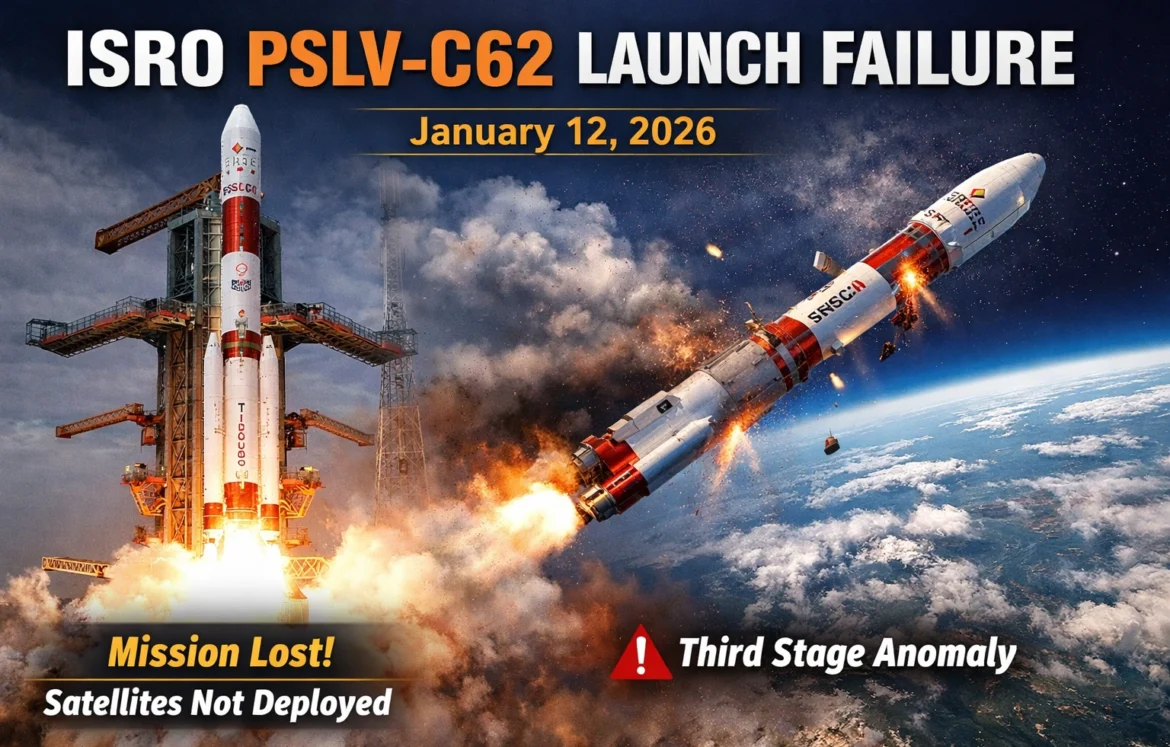
India’s space ambitions faced a temporary setback on 12 January 2026, when the Indian Space Research Organisation (ISRO) experienced an anomaly during the launch of its PSLV-C62 mission. The launch, which was intended to mark ISRO’s first mission of 2026, did not achieve its primary objective after the rocket lost control mid-flight.
Despite the setback, ISRO has termed the incident a learning opportunity and has begun a detailed investigation to identify the root cause.
What Was the PSLV-C62 Mission?
The Polar Satellite Launch Vehicle (PSLV), often referred to as the workhorse of ISRO, lifted off from the Satish Dhawan Space Centre, Sriharikota. The mission carried EOS-N1 (also known as Anvesha), an Earth-observation satellite, along with 15 co-passenger satellites from India and international customers.
The satellites were meant to be placed into low Earth orbit, supporting applications such as:
- Earth observation
- Environmental monitoring
- Technology demonstrations
What Went Wrong During the Launch?
According to initial information released by ISRO and reported by international space news agencies, the launch proceeded normally during the early stages. However, an anomaly occurred during the third stage of the PSLV, which caused the rocket to deviate from its planned trajectory.
As a result:
- The vehicle failed to reach the intended orbit
- All 16 satellites were lost
- The mission objectives could not be completed
Importantly, there was no explosion, indicating that some systems continued functioning, which may help investigators pinpoint the issue more precisely.
Why This Failure Matters
PSLV has an exceptional track record spanning more than three decades, with over 50 successful missions. This failure is significant because it is reported to be the second consecutive PSLV anomaly within a year, something rarely seen in the vehicle’s history.
While launch failures are not uncommon in space exploration globally, repeated issues naturally raise concerns about:
- Quality control
- System upgrades
- Reliability for commercial launches
ISRO’s Response and Preparedness
Before the launch, ISRO conducted multiple readiness and safety reviews, highlighting the high level of preparation behind the mission.
Following the failure, ISRO:
- Initiated a detailed failure analysis
- Began reviewing telemetry and flight data
- Assured stakeholders that corrective measures will be implemented before future missions
Historically, ISRO has bounced back strongly after setbacks, often returning with improved systems and successful missions.
Impact on India’s Space Program
While the PSLV-C62 failure is a setback, experts believe it is unlikely to derail India’s long-term space goals, which include:
- Gaganyaan human spaceflight mission
- Expanded commercial launch services
- Advanced Earth-observation and communication satellites
Globally, even leading space agencies like NASA and ESA have experienced launch failures. What matters most is how quickly and effectively lessons are learned.
What’s Next for PSLV?
ISRO is expected to:
- Release a detailed technical report after analysis
- Implement corrective actions
- Resume launches once safety and reliability are assured
The PSLV remains a critical part of India’s launch infrastructure, and this incident is widely seen as a temporary hurdle rather than a long-term problem.
Final Thoughts
The January 12 PSLV launch failure serves as a reminder that space exploration is inherently complex and risky. ISRO’s transparent approach and strong engineering foundation suggest that the organisation will emerge stronger from this challenge.
For India’s growing space ecosystem, this moment is not the end—but another step in the journey toward becoming a global space power.
