
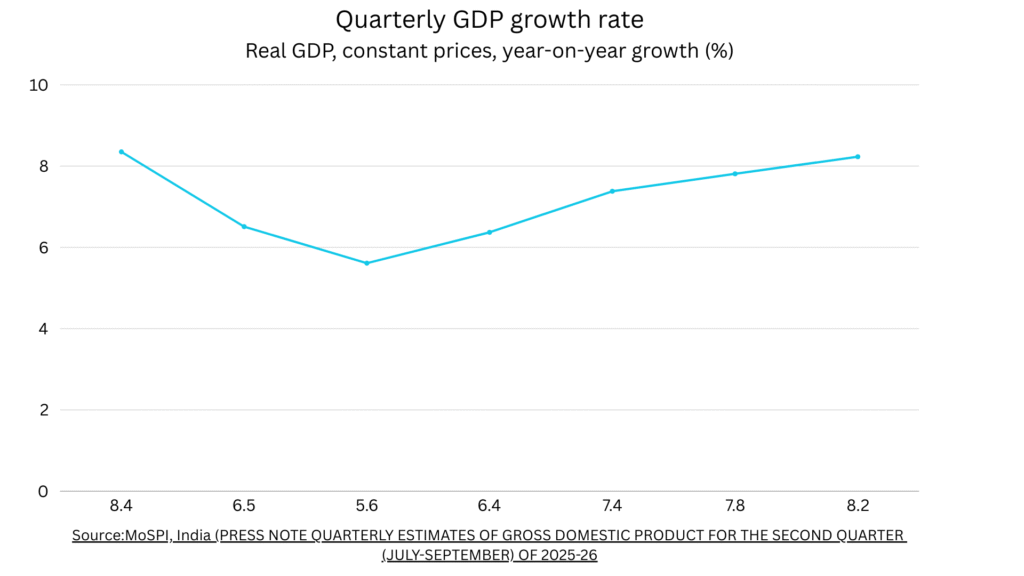
India’s GDP surges to an 8.2% growth rate — the highest in the past six quarters

As you have just opened the news, a positive update has happened in the world economy. India has achieved an 8.2% GDP growth in the quarter ending September 2025. It is the fastest pace seen in the last six quarters. The country is moving towards a new India, with massive growth in certain sectors. This growth can open up opportunities for businesses, entrepreneurs and new talents in digital marketing, manufacturing, services, and construction.
Let’s understand the factors of this growth and why this is the ideal time to enhance your skills, particularly in the digital economy.
What the Numbers Reveal
The 8.2% GDP growth in Q2 FY 2025-26 follows a 7.8% expansion in the previous quarter — signifying consistent momentum. On the production side, both industry and services contributed strongly: manufacturing output rose ~9.1%, while the services sector grew by ~9.2%. From the demand side, private consumption (household spending) witnessed a notable uptick — a key driver of growth. Even though nominal GDP (i.e. GDP at market prices) expanded by ~8.7%, some analysts caution that this remains modest relative to earlier years — which could affect fiscal projections such as tax revenues. According to official estimates, these numbers strengthen projections for full-year growth (FY 2025-26) to comfortably hover above 7%.
What’s Driving This Surge?
Several structural and cyclical factors appear to be fueling India’s economic upswing:
Robust performance in manufacturing and services: two of the largest contributors to GDP — indicates healthy industrial activity as well as sustained demand for services.
Increased consumer spending suggests renewed confidence among households, perhaps stemming from stable inflation, improving incomes, or better employment prospects.
Macro-economic stability and reforms — policymakers note that disciplined fiscal management alongside regulatory reforms is making business-climate more conducive.
The data also benefits from what analysts call a “favourable deflator effect” — meaning lower inflation/price pressures make real GDP growth look stronger.
Why This Matters — and What It Could Mean for India
An 8.2% growth rate — if sustained — would bolster India’s standing among the fastest-growing major economies globally. Higher GDP growth can translate to improved job opportunities, rising incomes, and better standards of living, especially if growth remains broad-based across sectors.
For businesses, robust demand and industrial activity can boost production, investment, and profitability — potentially generating more economic fuel down the line. For the government, stronger growth helps in improving fiscal health — though the relatively modest nominal GDP growth might pose challenges for revenue projections.
What to Keep an Eye On
The strong real-GDP growth is partially influenced by the low inflation / deflator effect. If inflation rebounds, real growth rates might moderate. Sectors like agriculture lag behind — suggesting uneven benefits; rural or agrarian communities may not feel as much of the growth surge yet. For long-term sustainability, growth needs to be backed by investment, infrastructure, job creation, and structural reforms, not just short-term consumption booms.
Conclusion
The latest GDP numbers — 8.2% growth in Q2 FY 2025-26 and strong performance across manufacturing, services and consumption — offer compelling evidence that the Indian economy is on a promising upswing. While the numbers are undoubtedly impressive, translating this growth into lasting prosperity for all will depend on consistent policy support, investment-led expansion, and inclusive development across sectors and geographies.
With cautious optimism, one can hope that 2025-26 marks the beginning of a sustained growth phase for India — one that not only strengthens macro-economic indicators, but also delivers tangible improvements to everyday lives.
