
German Chancellor Merz in India: Inside Germany’s First Official Visit to India in 2026
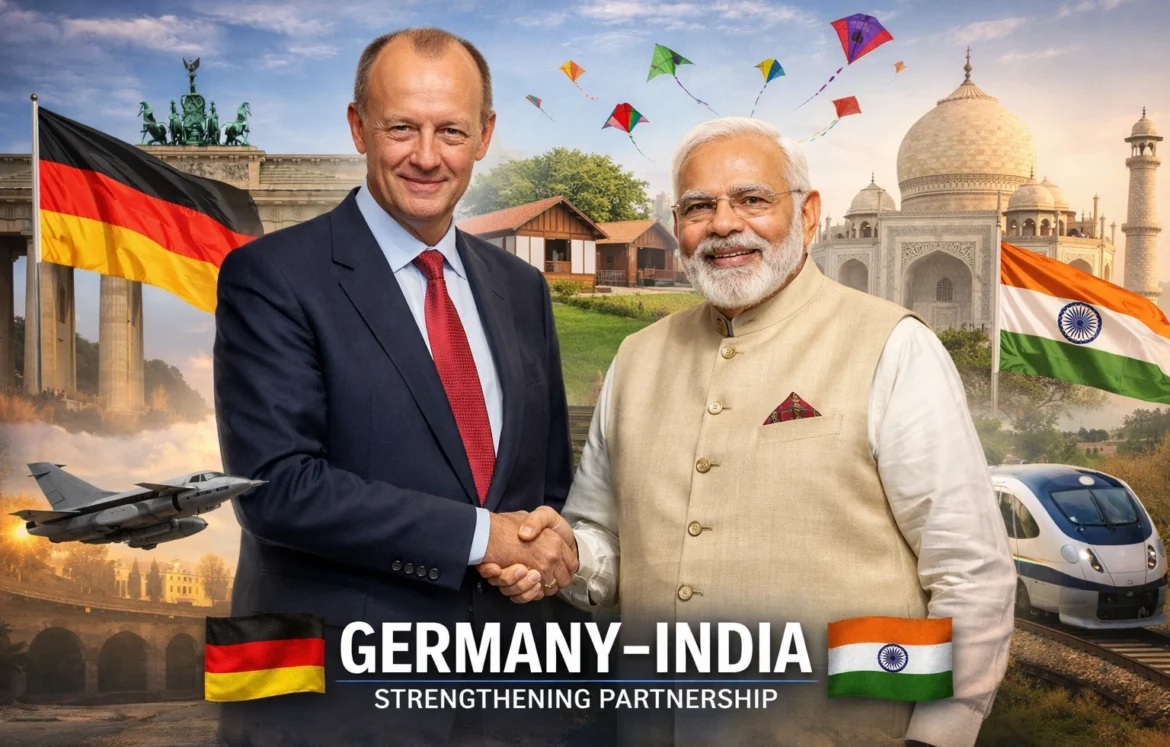
On January 12, 2026, German Federal Chancellor Friedrich Merz arrived in Ahmedabad, India, marking the beginning of his first official visit to India since taking office. The two-day trip — hosted by Prime Minister Narendra Modi — highlights the growing strategic importance of the India-Germany partnership at a time of evolving global geopolitical and economic challenges.
Why This Visit Is Significant
Germany chose India as one of its first major Asian stops under Chancellor Merz, signaling India’s rising global prominence as both an economic powerhouse and a strategic partner. This visit also comes as India and the European Union prepare for a planned summit, where discussions on a India-EU Free Trade Agreement are anticipated.
Highlights of the Visit
Arrival and Warm Welcome
Merz touched down at Sardar Vallabhbhai Patel International Airport in Ahmedabad, where he was welcomed by senior Indian officials. Afterwards, he attended a series of culturally symbolic events with Prime Minister Modi, including a visit to the Sabarmati Ashram, an iconic site associated with Mahatma Gandhi’s freedom movement.
International Kite Festival
One of the first public engagements was the Ahmedabad International Kite Festival, where both leaders participated in celebrations that brought together participants from around the world. The festival served as a unique platform to showcase cultural goodwill and people-to-people connections.
Bilateral Talks in Gandhinagar
Formal discussions were held at the Mahatma Mandir in Gandhinagar, where key agendas included strengthening cooperation in trade, investment, technology, and defence. More than a dozen agreements covering business, semiconductors, critical minerals, and skills development were reportedly on the table.
Major Areas of Cooperation
Trade & Economic Engagement
India and Germany already enjoy robust trade relations, with bilateral trade crossing record levels in recent years. As Germany looks to diversify its export markets amid global competition, India’s expanding economy offers promising opportunities for German investment and partnership.
Technology, Education & Mobility
Beyond goods, both governments are exploring deeper collaboration in education, research, and skilled workforce mobility. Efforts to expand joint programmes and mobility pathways could benefit students, researchers, and professionals in both countries.
Defence & Strategic Security
Defence cooperation has accelerated, with potential multinational projects and technology sharing under discussion — including talks around submarine co-production and naval collaboration. Germany’s support in maritime security and joint training also forms a critical component of future cooperation.
Sustainable Growth & Green Energy
Partnerships in clean energy, green hydrogen, and sustainable infrastructure were highlighted as mutual priorities, aligning with global goals on climate action and industrial transformation.
The Bigger Picture
Chancellor Merz’s visit isn’t just a diplomatic gesture — it represents a broader shift in how major economies are approaching global partnerships in an age of geopolitical flux. With competition among global powers intensifying and supply chains reconfiguring, Germany and India appear set to deepen cooperation beyond traditional boundaries.
Moreover, this high-level visit builds on 25 years of India-Germany Strategic Partnership and 75 years of diplomatic relations, laying the groundwork for future collaboration that spans economics, defence, technology, and people-to-people ties.
Conclusion
Chancellor Merz’s visit to India marks a defining moment in bilateral relations — one that blends strategic interests with cultural diplomacy. As both nations negotiate new agreements and expand cooperation, this visit could well be remembered as a turning point in Indo-German relations for decades to come.
