
Best Health Insurance Plans in India 2026 – Complete Guide for Every Indian Family
Medical bills in India have nearly tripled in the last decade. A treatment that cost ₹50,000 in 2014 can easily cross ₹1.5 lakh today — and medical inflation continues to rise at approximately 14% every year. For millions of Indian families, one hospital visit without adequate insurance can wipe out years of savings.
If you’ve been thinking “I’ll get health insurance later,” 2026 is the year to stop delaying. In this guide, we break down the best health insurance plans in India for 2026 — covering families, individuals, senior citizens, and working professionals — so you can make an informed decision without getting lost in the fine print.
Why Health Insurance Is No Longer Optional in 2026
India records the highest financial burden from medical bills among 12 Asian countries, according to data from Swiss Re. A single ICU admission, a cardiac procedure, or a cancer diagnosis can drain your life savings within days.
Here’s why health insurance matters more than ever:
- Rising lifestyle diseases: Diabetes, hypertension, and heart disease are now affecting people in their 30s
- Medical inflation: Hospital costs grow 12–14% annually, far outpacing salary hikes
- Tax benefit: You can claim deductions up to ₹25,000 (or ₹50,000 for senior citizens) on premiums under Section 80D of the Income Tax Act
- Cashless treatment: Most top insurers have 10,000+ empanelled hospitals for zero out-of-pocket payment during emergencies
What to Check Before Buying a Health Insurance Plan
Before comparing plans, understand these 5 key factors:
1. Claim Settlement Ratio (CSR)
This is the percentage of claims an insurer actually pays out. Always look for insurers with a CSR above 95%. A high CSR means they won’t find excuses to reject your claim when you need it most.
2. Network Hospitals
More network hospitals means easier cashless treatment — especially important if you live in a tier-2 or tier-3 city. Look for insurers with 10,000+ hospitals.
3. Waiting Period
Most plans have a waiting period of 2–4 years for pre-existing conditions. If you already have diabetes or hypertension, choose a plan with a shorter waiting period.
4. Sum Insured
Financial experts recommend a minimum cover of ₹10–15 lakh for a family of four in a metro city. With rising costs, ₹5 lakh is no longer enough.
5. No-Claim Bonus (NCB)
If you don’t make a claim in a year, many insurers increase your sum insured by 10–50% at no extra cost. Over 5 claim-free years, this can significantly boost your coverage.
Top 10 Best Health Insurance Plans in India 2026
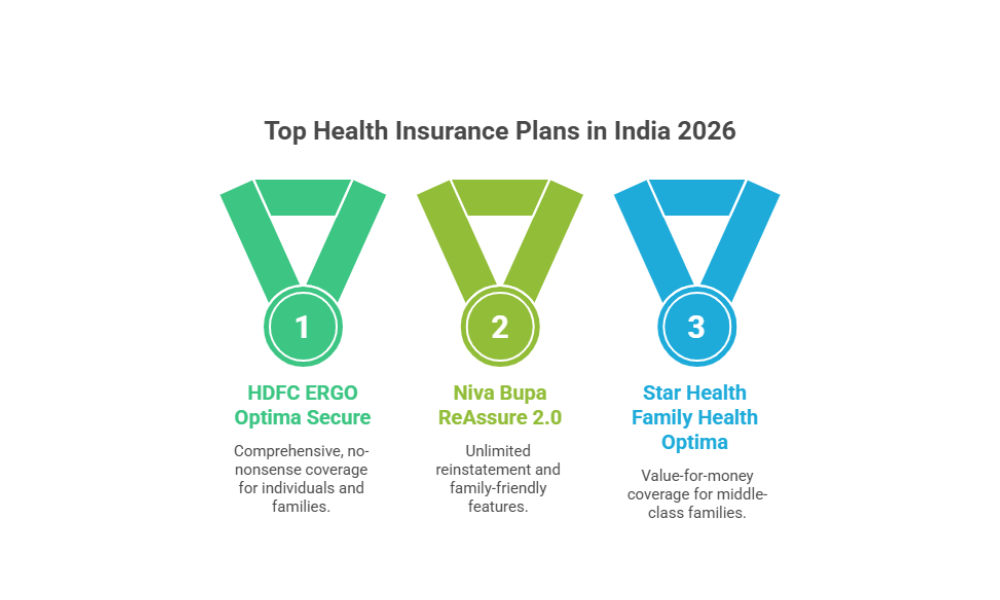
1. HDFC ERGO Optima Secure – Best Overall Pick
HDFC ERGO is consistently rated among India’s most reliable health insurers, with a claim settlement ratio above 98%. The Optima Secure plan is ideal for individuals and families who want comprehensive, no-nonsense coverage.
Key Features: – Coverage: ₹5 lakh to ₹2 crore – 2X coverage from Day 1 (₹10 lakh plan = ₹20 lakh actual protection) – 100% restoration of sum insured if exhausted – No sub-limits on room rent – No-Claim Bonus of up to 50% – Network: 13,000+ hospitals
Best For: Salaried professionals, families in metro cities Approximate Annual Premium (₹10 lakh, age 35): ₹12,000–₹18,000
2. Niva Bupa ReAssure 2.0 – Best for Families
Niva Bupa (formerly Max Bupa) holds the top spot in customer satisfaction, with the highest CSR among private health insurers. ReAssure 2.0 is their flagship family floater plan built for modern Indian households.
Key Features: – Unlimited reinstatement — sum insured refills every time it’s exhausted – Covers up to 6 family members under one policy – Built-in personal accident cover – Up to 30% discount on renewal for staying active (step-count based) – Pre and post-hospitalization covered – Network: 10,000+ hospitals
Best For: Young families, active professionals Approximate Annual Premium (₹10 lakh, family of 3): ₹14,000–₹22,000
3. Star Health Family Health Optima – Best Value for Families
Star Health is India’s largest standalone health insurer and holds an impressive claim settlement ratio. Family Health Optima is their most popular plan offering solid coverage at a competitive price.
Key Features: – Coverage: ₹3 lakh to ₹25 lakh (family floater) – One policy covers spouse and children – Cashless treatment at 14,000+ hospitals – Pre and post-hospitalization cover (60 and 90 days respectively) – Automatic restore of sum insured – Covers daycare procedures (no need for overnight admission)
Best For: Middle-class families looking for value-for-money coverage Approximate Annual Premium (₹10 lakh, family of 3): ₹10,000–₹16,000
4. ICICI Lombard Complete Health Insurance – Best for Young Professionals
ICICI Lombard is known for strong digital infrastructure and fast claim processing — ideal for young, tech-savvy professionals.
Key Features: – Coverage: ₹3 lakh to ₹50 lakh – Critical illness rider available (covers 20 listed illnesses) – International hospitalization cover (USA, Canada, and more) – In-built wellness benefits: video consultations, ambulance, doctor-on-call – 95%+ claim settlement ratio – Network: 15,000+ hospitals
Best For: Young professionals in metros, corporate employees Approximate Annual Premium (₹10 lakh, age 28): ₹8,000–₹13,000
5. Care Supreme Health Insurance – Best for Comprehensive Benefits
Care Health Insurance (formerly Religare Health) is popular for its wide coverage and flexible add-ons.
Key Features: – Coverage: ₹5 lakh to ₹6 crore – Unlimited restoration of sum insured – Daily hospital cash benefit – OPD (outpatient) cover available as add-on – Annual health check-up included – No sub-limits on room rent or treatment
Best For: Individuals and families wanting maximum coverage flexibility Approximate Annual Premium (₹10 lakh, age 35): ₹11,000–₹17,000
6. Aditya Birla Activ Health Platinum Enhanced – Best for Chronic Illness Management
Aditya Birla Health Insurance stands out with its “Health First” model — rewarding you for staying healthy while covering you when sick.
Key Features: – Covers chronic conditions (diabetes, hypertension) from Day 1 — no waiting period – Earn up to 100% HealthReturns™ as premium rewards for staying active – Network: 11,000+ hospitals – Pre and post-hospitalization cover – Mental health coverage included – Double sum insured after 2 claim-free years (at no extra premium)
Best For: People with pre-existing conditions, fitness-conscious individuals Approximate Annual Premium (₹10 lakh, age 35): ₹14,000–₹20,000
7. SBI General Super Health Platinum Infinite – Best for High Coverage
SBI’s top-tier plan packs serious coverage benefits for those who want maximum protection.
Key Features: – Unlimited reinstatement — up to 200% of base sum insured per claim – Health Multiplier: boosts cover by 3X for serious illnesses – Global treatment option for critical conditions diagnosed in India – Shorter waiting periods: 2 years for pre-existing diseases, 1 year for specific diseases – Consumables covered (PPE, gloves, syringes)
Best For: High-income earners, those seeking premium coverage Approximate Annual Premium (₹10 lakh, age 35): ₹15,000–₹25,000
8. Tata AIG MediCare Plus – Best Top-Up Plan
If you already have basic health coverage (like a corporate plan from your employer), Tata AIG MediCare Plus is a great top-up to extend protection at low cost.
Key Features: – Deductible options: ₹2 lakh to ₹20 lakh – Coverage available up to ₹2 crore – Very affordable premium compared to base plans – Claim settlement ratio above 95%
Best For: Working professionals with corporate health cover who want extra protection Approximate Annual Premium: ₹3,000–₹8,000 (varies widely by deductible and age)
9. Bajaj Allianz My Health Care – Best Customizable Plan
Bajaj Allianz offers one of the most modular plans in the market — you build your own coverage.
Key Features: – Sum insured up to ₹5 crore – OPD benefit of 2X the annual premium – International cover option (emergency) – Fully customizable: choose only the features you need – Excellent customer service and quick claim turnaround
Best For: Self-employed individuals, freelancers, small business owners Approximate Annual Premium (₹10 lakh, age 35): ₹12,000–₹18,000
10. ManipalCigna Health Insurance – Best for Preventive Care
A joint venture combining India’s largest healthcare chain with global insurance expertise, ManipalCigna focuses on prevention alongside treatment.
Key Features: – 2-year waiting period for pre-existing diseases (below the industry average) – Free health check-ups included – Up to 35% premium discounts (including 5% for online purchase) – Recognized as “Best Innovation for Products in 2026” – Strong network of 8,000+ hospitals
Best For: Families prioritizing preventive healthcare Approximate Annual Premium (₹10 lakh, age 35): ₹10,000–₹16,000
Types of Health Insurance Plans in India
Not all health plans are the same. Here’s a quick breakdown:
| Plan Type | Best For | Key Feature |
| Individual Plan | Single person | Dedicated sum insured for one person |
| Family Floater | Families | Shared sum insured, typically more affordable |
| Senior Citizen Plan | Age 60+ | Higher premiums but covers age-specific illnesses |
| Critical Illness Plan | High-risk individuals | Lump sum payout on diagnosis of serious illness |
| Top-Up Plan | Those with basic coverage | Extends coverage beyond base plan limit |
| Group Health Insurance | Employers | Corporate coverage for employees |
How Much Health Insurance Coverage Do You Actually Need?
A common rule of thumb: your health cover should be 1–3 times your annual income, or at minimum: – Individual (below 35, no pre-existing conditions): ₹5–10 lakh – Family of 4 (metro city): ₹15–25 lakh – Senior citizens: ₹10–25 lakh (with critical illness add-on) – With pre-existing conditions: ₹15–50 lakh
Given 14% annual medical inflation, it’s better to buy slightly more coverage today than too little tomorrow.
Quick Comparison Table: Top 5 Plans at a Glance
| Plan | CSR | Network Hospitals | Min Sum Insured | Unique Feature |
| HDFC ERGO Optima Secure | 98%+ | 13,000+ | ₹5 lakh | 2X coverage from Day 1 |
| Niva Bupa ReAssure 2.0 | 97%+ | 10,000+ | ₹5 lakh | Unlimited restoration |
| Star Health Family Optima | 99%+ | 14,000+ | ₹3 lakh | Best CSR in industry |
| ICICI Lombard Complete | 95%+ | 15,000+ | ₹3 lakh | International cover |
| Aditya Birla Activ Health | 96%+ | 11,000+ | ₹4 lakh | Day 1 chronic illness cover |
Tips Before You Buy
- Buy young: Premiums are significantly cheaper in your 20s and 30s. The same plan that costs ₹8,000/year at age 28 may cost ₹25,000+ at age 50.
- Read the fine print: Pay attention to sub-limits on room rent, co-pay clauses, and disease-specific caps.
- Compare online: Use platforms like Policybazaar or Ditto to compare plans side by side.
- Don’t rely only on corporate cover: Employer plans typically end when you leave the job. Always maintain a personal health plan.
- Check pre-existing disease coverage: If you have conditions like diabetes or thyroid issues, choose a plan with shorter waiting periods.
FAQs
Q1: Which is the No. 1 health insurance company in India for 2026?
Based on claim settlement ratio, Niva Bupa and Star Health lead the pack. For plan features, HDFC ERGO Optima Secure is consistently rated the top all-round choice.
Q2: Is ₹5 lakh health insurance enough for a family in 2026?
Not really, especially in metro cities. With hospital costs rising every year, ₹10–15 lakh is recommended as a minimum for a family of four.
Q3: Can I get tax benefits on health insurance premiums?
Yes. Under Section 80D of the Income Tax Act, you can claim up to ₹25,000 per year for premiums paid for yourself, spouse, and children — and an additional ₹25,000 for parents (₹50,000 if they’re senior citizens).
Q4: What is a family floater plan?
A family floater plan covers all family members under a single policy with a shared sum insured. It’s usually more affordable than buying separate individual policies for each person.
