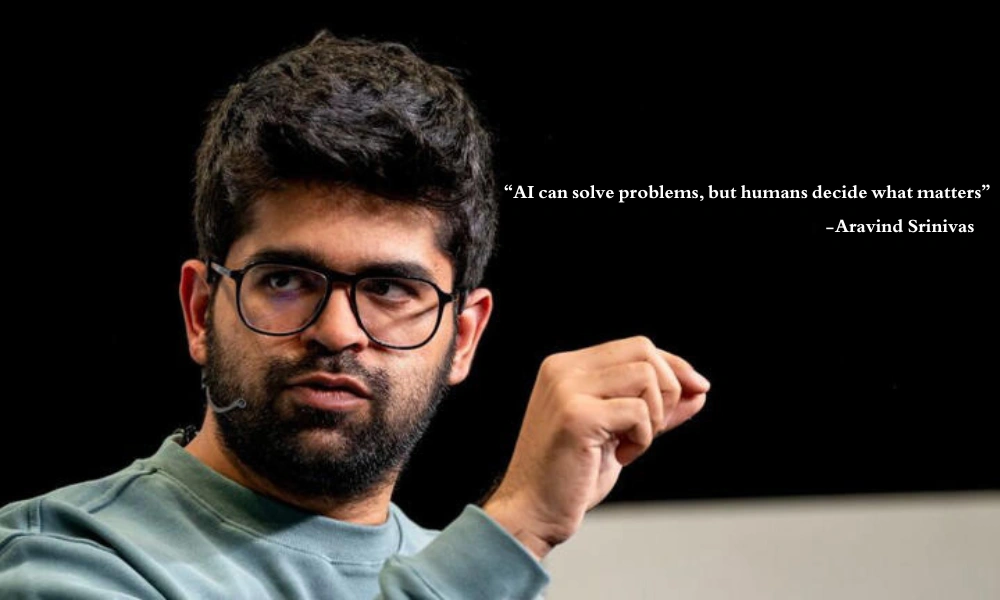
Artificial Intelligence (AI) is transforming the way we work, think, and solve complex challenges. From generating content to analyzing massive datasets, AI systems are becoming faster and smarter every day. However, according to Aravind Srinivas, CEO of Perplexity AI, there is one crucial role that AI cannot replace — deciding what truly matters.
In a recent discussion, Srinivas highlighted an important truth: while AI excels at problem-solving, humans are still responsible for defining priorities, values, and purpose. This perspective offers a balanced understanding of AI’s role in the future.
What Aravind Srinivas Means
Aravind Srinivas explains that AI works exceptionally well once a problem is clearly defined. It can:
Process large amounts of information
Provide accurate answers quickly
Optimize solutions better than humans in many cases
However, AI does not possess curiosity, intent, or emotional intelligence. It cannot decide which problems are worth solving. That responsibility lies with humans, who understand social impact, ethics, and long-term consequences.
In simple terms:
AI answers questions. Humans decide which questions are important.
AI as a Powerful Tool, Not a Decision-Maker
AI systems depend on human input. They are trained on data, guided by prompts, and evaluated by people. Without human direction, AI has no purpose.
Humans play a key role in:
Setting goals Choosing ethical boundaries Determining business and societal priorities Applying AI insights responsibly
This makes AI a support system, not a replacement for human judgment.
Why Human Judgment Still Matters
Many real-world decisions involve emotions, culture, morality, and empathy — areas where AI falls short. For example:
Healthcare decisions involve compassion and ethics Business strategies require vision and risk assessment Social issues need human values and understanding
AI can support these areas with data and analysis, but final decisions must be made by humans.
The Future of AI and Humans Working Together
The future is not about humans versus AI — it’s about collaboration. AI will continue to:
Improve productivity Reduce repetitive work Enhance research and innovation
Meanwhile, humans will:
Define purpose Ask meaningful questions Ensure responsible and ethical AI use
This partnership can lead to smarter, more impactful outcomes.
Conclusion
Aravind Srinivas’s statement offers a powerful reminder: technology should serve humanity, not replace it. AI may solve problems efficiently, but humans decide what is worth solving. In a rapidly evolving digital world, human values, curiosity, and judgment remain irreplaceable.
By understanding AI as a tool — not a decision-maker — we can use it wisely to build a better future.